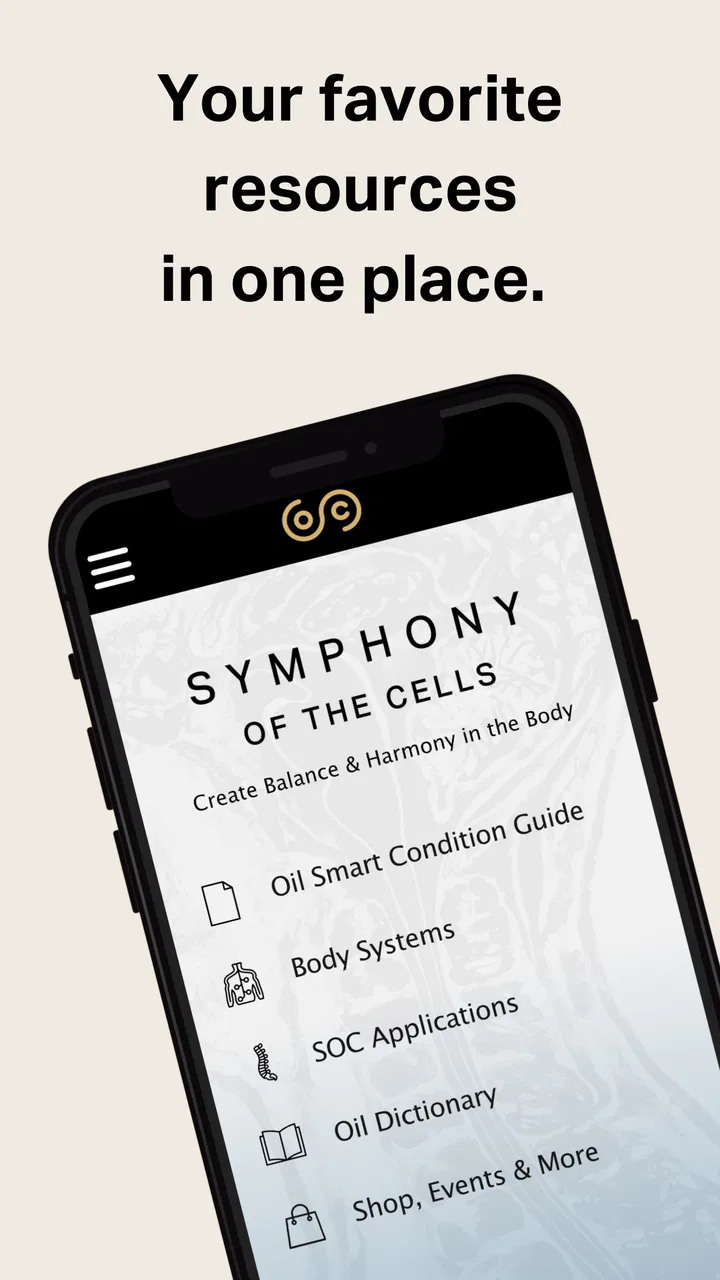
Symphony of the Cells
- 1.3
- Rating
- 10.00K
- Installs
- Free
- Price

 Analysis by App-foxy
I approached Symphony of the Cells as a reference tool rather than as a general health app. Its purpose is narrow: it helps users cross-reference remedies with their preferred Symphony of the Cells applications. That focus makes it potentially useful for people who already follow this particular wellness system, but it also means the app is not designed to replace a doctor, a medical diagnosis, or evidence-based treatment planning.
The app is free to download, with optional in-app purchases ranging from $4.99 to $29.99 per item. It is listed for everyone, runs on Android devices using version 7.0 or later, and is currently at version 3.1.4. Truman Global LLC is the developer. Those details make it fairly accessible from a device-compatibility perspective, although the low average rating of 1.3 from around 70 ratings is an important warning to consider before relying on it.
How the current version feels in everyday use
The central idea is straightforward. Instead of searching through notes, printed material, or a collection of remembered recipes, I can use the app as a lookup point when I want to connect a concern with a Symphony of the Cells application. That can save time for someone who already understands the terminology and wants a more convenient way to consult the system.
You May Also Like

 Pandora - Music & Podcasts
Pandora’s Music Is Easy to Start, but Harder to Recover
Pandora’s strength is its low-effort path from a seed to a station. Its weak spot is how much confidence it asks you to place in connection, setup, and quiet recovery.

 AccuWeather: Weather Radar
AccuWeather Review: A Quick, Clear Forecast for Everyday Decisions
For everyday plans, the best forecast is the one you can understand quickly. AccuWeather makes rain timing, radar, and local conditions easy to act on, with a few trade-offs.

 Hill Climb Racing
Why Hill Climb Racing Still Turns Crashes Into One More Run
A tiny car, a bumpy hill and one more upgrade: Hill Climb Racing keeps resurfacing because its simple chaos makes every near-miss feel personal.

 AliExpress - Shopping App
AliExpress Makes Global Shopping Feel Personal, but Shoppers Bear the Risk
AliExpress turns a global marketplace into a pocket-sized discovery engine. Its reach is useful, its shopping loop compelling, and its trade-offs easy to miss.

 Lords Mobile: Kingdom Wars
Lords Mobile Is a Kingdom-Building Routine, Not a Quick Match
A case-by-case verdict on the building, battles, device demands, and social commitments that make Lords Mobile rewarding for some players and exhausting for others.

 PDF Scanner app - TapScanner
TapScanner Makes Paperwork Easier to Capture, Check, and Share
TapScanner makes scanning with a phone feel less like a rescue operation and more like a dependable step in getting work done. Its capture tools are useful, though not flawless.
More From Our News Desk
View All News


For a newcomer, however, the narrow focus becomes a hurdle. The app’s short store description, “Symphony of the Cells,” does not explain the workflow in much detail. I would not install it expecting a broad symptom checker, a medication database, a telehealth service, or a conventional medical reference. Its value depends heavily on already knowing what kind of remedy or application I am looking for.
That distinction matters because the word “remedy” can sound more medically authoritative than the app itself should be treated. I would use the information as a personal reference for a wellness routine, not as a basis for changing prescribed medication or delaying professional care. Persistent, severe, or unexplained symptoms need qualified medical attention regardless of what a cross-reference suggests.
A practical workflow for returning users
A realistic use case would be a person preparing for a familiar wellness session at home. They may remember the general concern but not the exact application associated with it. Opening the app first can be quicker than searching a long message thread or flipping through handwritten notes. The useful habit is to treat the result as a starting point: identify the relevant application, check the ingredients or instructions from a trusted source, and then decide whether it fits the situation.
I would also keep a separate personal note of what I searched, what I actually used, and how I felt afterward. That is not a built-in feature I am attributing to the app; it is a practical workaround for a limitation of reference tools. Without a simple record, it is easy to confuse one application with another or assume that a previous experience proves something will work again.
Another non-obvious trade-off is speed versus context. A cross-reference can surface a familiar option quickly, but quick retrieval may encourage people to skip questions about allergies, sensitivities, pregnancy, interactions, or the seriousness of the symptom. In my view, the faster the lookup feels, the more deliberately I should slow down before acting on it.
What the version information tells existing users
The current version is 3.1.4, while the app was released on August 26, 2021. That suggests an established product that has received later version work rather than remaining exactly as it began. Still, a version number by itself does not reveal whether the most important changes were interface improvements, content revisions, compatibility updates, or corrections behind the scenes.
For someone who used an earlier release, the sensible approach is to update and then test the tasks that matter most: finding a known application, moving between related entries, and confirming that familiar terminology still appears where expected. I would not assume that an update automatically means the reference content has been medically reviewed or expanded in a particular way. Version evolution is useful evidence that the product is maintained, but it is not proof of clinical quality.
New users should judge the current experience on its own merits rather than relying on the fact that the app has been available for several years. An older release date can be reassuring when compatibility matters, yet it can also mean that the design reflects an earlier style of mobile reference app. The actual question is whether the lookup process is clear enough for the user’s routine.
Who is likely to get real value from it
I see the strongest fit among people who already use Symphony of the Cells applications and want a portable cross-reference. For that audience, the app can act as a compact companion during planning, especially when the alternative is carrying printed pages or maintaining a large collection of screenshots.
It may also suit a practitioner or household organizer who repeatedly needs to locate the same kinds of entries. In that case, the benefit is not that the app teaches medicine; it is that it puts a familiar framework in one place. The time saved can be meaningful when the user already knows the boundaries of the system and does not need extensive explanation.
The age rating of Everyone makes the app broadly approachable from a store-classification standpoint, but I would not interpret that as a recommendation for children to make health decisions independently. A parent or responsible adult should remain involved, particularly when a child has a significant condition, takes medication, or may react to an ingredient.
The app is less suitable for someone who wants impartial comparisons between conventional treatments and alternative approaches. It is also a poor match for anyone seeking symptom triage, diagnostic reasoning, dosage guidance for prescription drugs, emergency advice, or a conversation with a licensed professional. A mainstream medical reference, pharmacist, clinician, or emergency service is the better option in those situations.
Where it differs from ordinary medical alternatives
Most medical apps are organized around symptoms, conditions, medication schedules, health records, or appointments. This one is organized around a specific wellness framework and its applications. That makes it more specialized than a general symptom checker, but also less useful outside that framework.
A symptom checker usually asks several questions and may direct the user toward levels of care. A medication app typically focuses on reminders, interactions, or prescription details. Symphony of the Cells does not occupy either role in the way I would expect from those categories. Its appeal is the direct connection between a user’s chosen remedy system and the applications associated with it.
Compared with a printed manual, the app should be easier to carry and search, assuming the relevant content is presented clearly. Compared with personal notes, it may reduce the risk of losing a page or forgetting the name of an application. The trade-off is dependence on the app’s organization and any purchase decisions inside it. A paper reference has no update screen or digital access issue, while an app can be more convenient when I need an answer quickly.
I would not choose it over a trusted clinical resource when accuracy, diagnosis, or treatment safety is the main concern. I would choose it only when the specific Symphony of the Cells workflow is already part of my routine and I want a dedicated reference instead of a general health tool.
Costs, expectations, and the low rating
The free entry point lowers the barrier to trying it, but the optional purchases deserve attention before I build my routine around the app. Individual items cost between $4.99 and $29.99. Because the app’s core appeal is reference access, I would first explore what is available without paying and identify exactly which material requires a purchase.
I would also avoid buying several items immediately just because the app appears relevant. A better approach is to test one concrete workflow: search for an application I already know, see whether the result is understandable, and decide whether the organization genuinely saves time. If the free portion does not feel clear or useful, paying for more content is unlikely to solve a basic usability problem.
The average rating of 1.3 from around 70 ratings is the clearest sign that the experience has caused substantial dissatisfaction for some users. Ratings do not explain every individual problem, so I would not treat the number as a complete technical diagnosis. I would treat it as a reason to be cautious about purchases, keep expectations modest, and avoid depending on the app as the only place where important information is stored.
There are around 10,000 installs, which indicates that the app has reached a real audience but remains specialized rather than mainstream. That scale fits the product’s focused purpose. It also means I would place more weight on my own trial of the lookup process than on assuming that popularity guarantees polish.
Remaining gaps that affect trust
The biggest gap is context. A cross-reference is useful only when the user understands what the result means and what it does not mean. I would like any health-oriented reference to make the boundary between wellness information and medical care unmistakable, particularly when a person may be tempted to use a suggested application for a serious symptom.
Another concern is verification. The app can point me toward a remedy or application, but a lookup result alone does not answer whether the ingredients are appropriate for my body, whether they conflict with an existing treatment, or whether the underlying claim is supported by reliable clinical evidence. Those checks remain outside the simple act of cross-referencing.
There is also a practical continuity issue. If I rely on an app for repeated routines, I want confidence that I can still understand my notes and decisions if the app changes. My workaround would be to keep a concise offline record of the application name, the reason I considered it, and any advice received from a qualified professional. That protects against confusion after updates and prevents the app from becoming my only memory of a health decision.
People who need accessibility features, highly detailed explanations, or a broad educational path should evaluate the interface carefully before committing. A specialized lookup tool can be efficient for an experienced user while feeling opaque to someone encountering the terminology for the first time.
What I would watch in future updates
For future releases, I would pay attention to whether the developer improves clarity around the app’s intended role, makes the difference between reference material and medical advice easier to understand, and explains content changes in a way that existing users can follow. Those improvements would matter more to me than cosmetic redesign alone.
I would also look for a smoother way to revisit frequently used applications without weakening the reference structure. A useful balance would let experienced users move quickly while still presenting enough context for a careful decision. Clear explanations of what is included in each optional purchase would be equally important, since the current price range makes it sensible to understand the value before spending.
Existing users should check familiar searches after every update rather than assuming that their routine is unchanged. New users should begin with one or two specific tasks, not a large purchase. That small test reveals whether the app fits their way of thinking and whether its terminology is accessible enough for regular use.
My recommendation for the right reader
I can recommend trying Symphony of the Cells to someone who already follows this exact wellness approach and wants a dedicated mobile cross-reference. The free download makes a cautious trial possible, and the specialized structure may be more convenient than scattered notes or printed references.
I would not recommend it as a general medical app, a diagnostic tool, or a substitute for professional care. The low rating, optional purchase range, limited public description, and narrow purpose all argue for testing it carefully before spending money or making it part of an important health routine.
My final view is practical rather than enthusiastic: use it as a convenience layer, not as your health authority. If it helps you locate familiar applications quickly and you already know how to evaluate them safely, it may earn a place on your phone. If you need diagnosis, treatment safety, medication guidance, or dependable clinical context, choose a qualified professional and a medical resource built for that job instead.
FAQs for Symphony of the Cells
01What is Symphony of the Cells?
Symphony of the Cells is a wellness and essential-oil reference app based on the Symphony of the Cells technique. It provides information about oil blends, application sequences, body areas, and suggested protocols intended to support relaxation and general well-being. It should be viewed as a complementary wellness resource rather than a replacement for professional medical advice, diagnosis, or treatment.
02What can I do with the Symphony of the Cells app?
The app is designed to help users explore different Symphony of the Cells protocols and review the oils or application steps associated with each one. Depending on the available version and content, you may be able to browse protocol descriptions, follow an organized sequence, and save or revisit useful information. Its main value is as a portable reference for people already interested in this wellness method.
03Is Symphony of the Cells safe for everyone to use?
Not necessarily. Essential oils may cause skin irritation, allergic reactions, breathing problems, or other unwanted effects, especially when used incorrectly. Extra caution is important for children, pregnant or breastfeeding individuals, older adults, pets, and people with asthma, allergies, sensitive skin, or ongoing medical conditions. Read product instructions carefully and consult a qualified healthcare professional before using any protocol.
04Does Symphony of the Cells replace medical treatment?
No. The app presents complementary wellness information and should not be used to diagnose illnesses, treat serious symptoms, or replace medication prescribed by a doctor. Claims associated with essential oils and bodywork may not apply equally to everyone, and scientific evidence can vary by use. Seek professional medical care for persistent, severe, or worsening symptoms instead of relying only on the app.
05Is Symphony of the Cells free to download and use?
Availability, pricing, and included content can vary depending on the platform, region, and current app version. Some features or protocols may be accessible at no cost, while additional material could require an in-app purchase, subscription, or separate access. Before downloading, check the official Google Play or App Store listing for the latest price, permissions, supported devices, privacy information, and purchase conditions.
Pros
- Offers guided sound sessions designed for relaxation and emotional balance.
- Simple interface makes it easy to browse and start individual sessions.
- Includes content suitable for quiet personal wellness routines.
- Audio-based format lets users participate without watching the screen.
- Can complement meditation
- breathing exercises
- or other calming practices.
Cons
- Benefits are subjective and may vary considerably between users.
- Some content or features may require a subscription or additional payment.
- The wellness claims may not be supported by strong clinical evidence.
- Requires headphones or a quiet environment for the best listening experience.
- Limited appeal for users seeking interactive workouts or conventional meditation tools.

Symphony of the Cells
Gallery